

Michelle understands where the pressure on your tax bill comes from, because she’s spent more than a decade examining budgets line by line, year after year.
Newtown deserves a representative who treats your property taxes as the pressing problem it is.
———–
I’ve been knocking on a lot of doors to find out what matters to Newtown, and more than anything, I hear about property taxes.
Property taxes are set locally, but several of the fastest-growing costs in Newtown’s budget are shaped by decisions made in Hartford. State education aid, special-education reimbursements, employee healthcare costs, and energy prices all affect how much the town must raise from local taxpayers. Understanding those connections is essential to providing meaningful property-tax relief.
The first problem: an education funding formula that hasn’t moved in decades
Connecticut funds public schools through a formula called Education Cost Sharing, meant to distribute state education aid among municipalities, with the goal of equalizing towns’ ability to finance public education. The program grew out of the constitutional education-equity issues raised by the Horton v. Meskill litigation..
But despite good intentions, the state hasn’t raised its base per-pupil funding amount in 13 years.
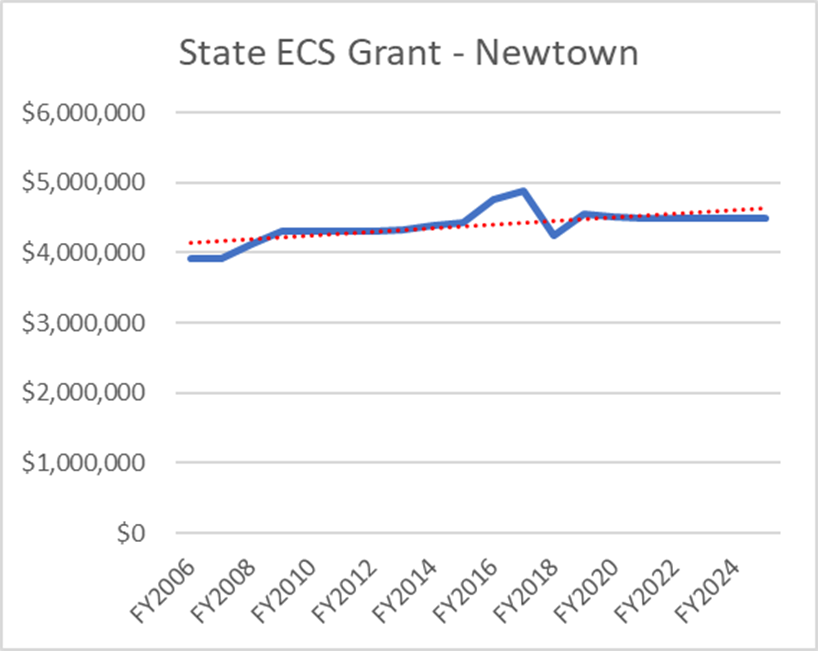
Meanwhile, the actual cost of running our schools keeps rising.
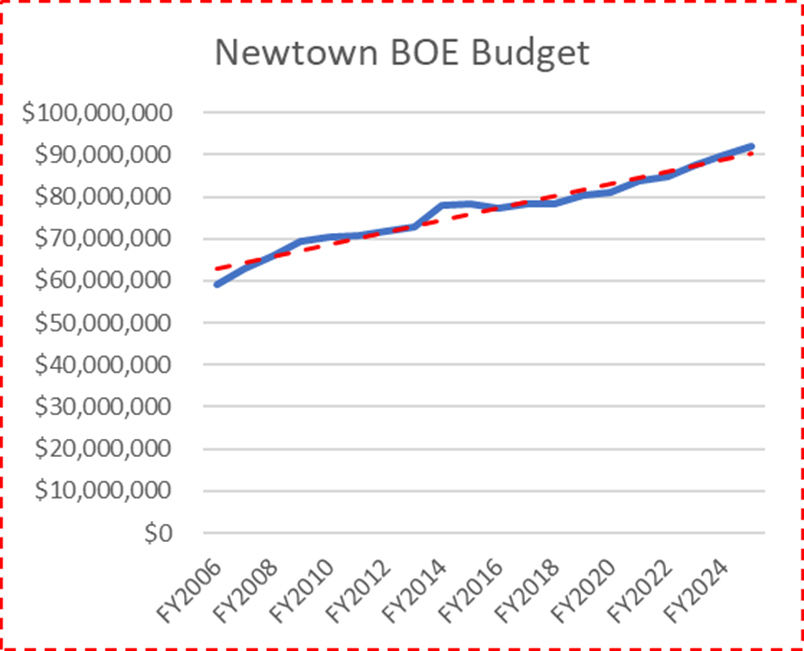
- ECS grant to Newtown: $4.31M (FY2011) → $4.50M (FY2025) — up only ~4% over the last 15 years
- Inflation has increased 43% in that same time period
- And the Newtown BOE budget is up ~30% over the last 15 years
When the state’s contribution stays frozen while inflation goes up, the difference doesn’t disappear. It lands on Newtown’s property tax bills.
Additionally, the cost of special education has risen over the years. Despite the overall student population declining, the number of students identified for services has risen in the state Yet the Excess Cost Grant, like the ECS funding, has not kept up with the need.
There is no reason, especially when the state runs surpluses year after year, for the state not to share fairly in the cost of educating our children. Flat funding defeats the purpose of the Education Cost Sharing formula, and it leaves an ever-greater share to local property taxpayers.
The second and third problems: healthcare and energy costs hit us twice
Here’s the issue that many of us don’t think about – rising healthcare and energy costs don’t just affect your household budget. They hit you a second time, through your property tax bill.
Health insurance premiums for staff and municipal employees are one of the fastest-growing line items in Newtown’s town budget. When healthcare costs rise statewide or nationally, that pressure flows directly into the budget you vote on every year.
Energy costs work the same way. Heating and powering our schools, town buildings, and infrastructure is a major and growing municipal expense. When energy costs rise, so does the town budget, and so does your tax bill.
So every time healthcare and energy costs go up, Newtown families feel it twice: once in their own premiums, deductibles, and utility bills, and again when the town has to cover the same rising costs for teachers, staff and town employees, and passes the costs along through the mill rate.
Why this matters for how we fix property taxes
This is why I don’t think property tax relief can be solved at the municipal level. If we’re serious about bringing property taxes under control, we have to be serious about all three of the drivers:
Updating the state’s Education Cost Sharing and Excess Cost Grant formulas, so Newtown isn’t stuck making up a growing gap in state education funding every year.
Addressing healthcare costs at the state level (and the federal level), so premiums for school staff and municipal employees stop climbing faster than town budgets can absorb.
Increasing our energy supply and modernizing an aging system, without abandoning the environmental protections that keep our air and water clean, so heating and powering our public buildings gets less expensive over time, not more.
Real State-Level Policy Solutions
Municipalities cannot fix state-level cost drivers alone. To deliver lasting property tax relief, Hartford must focus on systemic reforms such as:
- Update the ECS Formula & Fully Fund Special Education: Modernize base funding and fully fund the Special Education Excess Cost Grant so local taxpayers don’t shoulder unexpected cost spikes.
- Expand Direct Relief: Increase the state Property Tax Income Tax Credit and strengthen state-funded circuit-breaker programs to protect seniors and fixed-income residents from rising valuations.
- Contain Healthcare & Energy Overhead: Drive state-level healthcare purchasing pools, hold insurance companies accountable, remove Pharmaceutical Benefits Manages, and invest in grid modernization to bring down utility costs for public facilities over time.
What I’ll bring to Hartford
I understand where the pressure on your tax bill comes from, because I’ve spent more than a decade examining budgets line by line, year after year.
Newtown deserves a representative who treats this as the pressing problem it is.
Leave a Reply